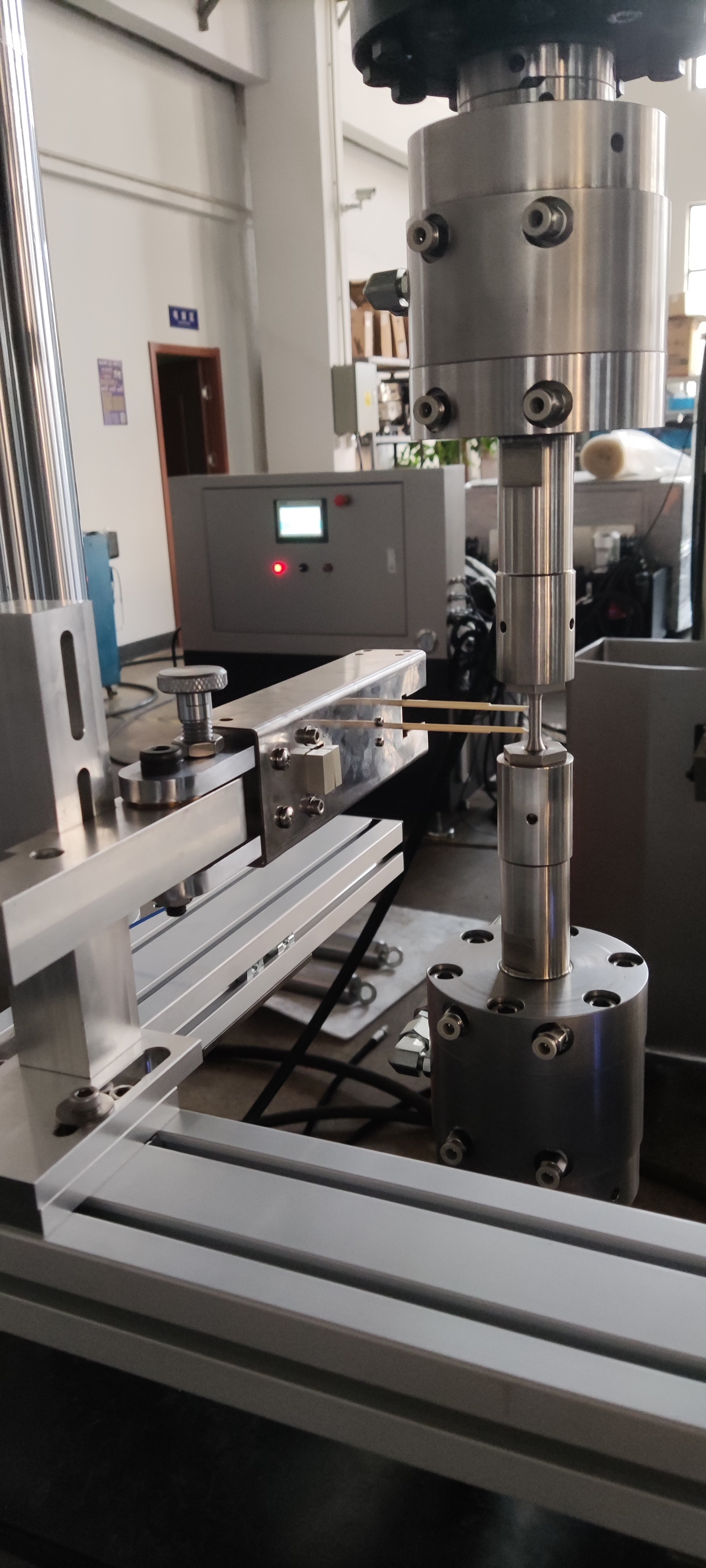
During their service life, parts and components are not only subjected to static loads but also periodic or non-periodic alternating loads. Although the value of the alternating loads may be much lower than their stress limit, failure phenomena such as relaxation and fracture can still occur. This is because materials and components are not ideally perfect structures—there are defects during the manufacturing process. Even tiny defects, under the repeated action of alternating loads, will cause microstructural changes in local areas of the components. As the loading duration increases, these changes continue to evolve, leading to macroscopic phenomena such as protrusions, depressions, necking, and cracking, which ultimately result in service failure.
The stress-controlled fatigue test is designed to simulate the service conditions of materials under low loads. By applying different loading amplitudes, corresponding service cycles are obtained to form reliable S-N curves for design reference. Unlike static strength tests, alternating loads have a cumulative effect. Therefore, the dynamic error between the actual load value of the specimen and the designed load, as well as the actual stress state, both affect the reliability of the final test data.
Lishi's LF series test systems adopt high-stiffness loading frames, electro-hydraulic servo loading, and real-time control systems with a closed-loop rate of up to 10 kHz, endowing the system with higher bandwidth and better loading stability. Professional test software further improves the efficiency of subsequent data processing. Our professional R&D team can promptly track market trends and provide professional solutions.